

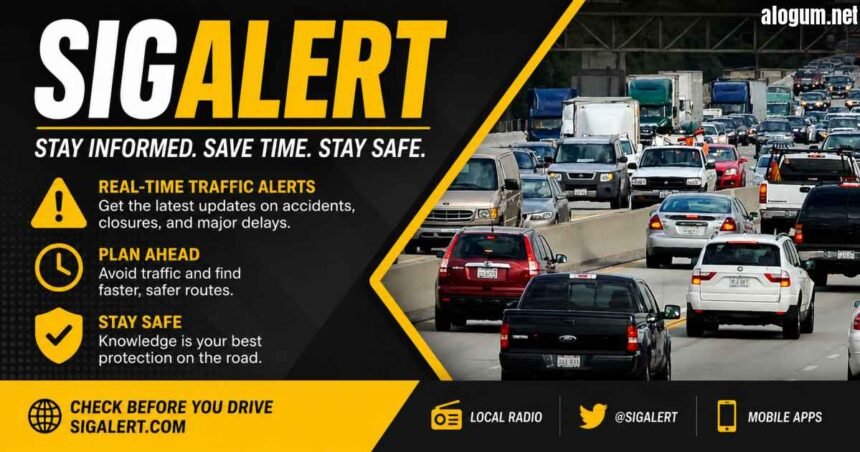
If you live in California or regularly drive on busy freeways in Los Angeles, you’ve almost certainly heard the term SigAlert. In 2026, SigAlert is much more than a radio traffic announcement—it’s a real-time traffic alert system relied upon by millions of commuters, truck drivers, rideshare drivers, emergency responders, and logistics companies to avoid delays and travel more safely.
Whether you’re driving on I-405, I-5, US-101, I-10, or navigating traffic in the San Francisco Bay Area or Sacramento, understanding how SigAlert works can save you hours of frustration. This complete SigAlert 2026 guide explains what it is, how it works, its history, where to check live updates, and why it remains one of California’s most trusted traffic information systems.
What Is a SigAlert?
A SigAlert is an official traffic advisory issued by the California Highway Patrol (CHP) and supported by Caltrans when a traffic incident causes significant disruption expected to last 30 minutes or longer.
Unlike ordinary congestion updates, a SigAlert is reserved for major traffic incidents that require drivers to consider alternate routes. According to the California Highway Patrol, the official standard defines a SigAlert as an unplanned event that closes at least one traffic lane for 30 minutes or more. While many CHP communication centers now commonly issue SigAlerts for incidents involving two or more blocked lanes, the official statewide definition remains one lane closed for at least 30 minutes.
A SigAlert may be issued when:
- A traffic accident blocks one or more lanes for 30 minutes or longer
- A hazardous materials (hazmat) spill creates unsafe road conditions
- A major freeway closure requires immediate rerouting
- Police activity significantly disrupts freeway traffic
- Fires, flooding, mudslides, or other hazardous road conditions impact travel
It’s important to distinguish between planned and unplanned events. Scheduled construction projects and planned freeway closures are generally announced as Traffic Advisories, not SigAlerts.
Simply put, if your navigation app reports “heavy traffic,” you might experience a delay. If a SigAlert is issued, it’s a strong indication that you should avoid the affected area whenever possible.
History and Origin of SigAlert
The history of SigAlert dates back to 1955 and is uniquely tied to Southern California.
The system was invented by Loyd C. Sigmon, a Los Angeles radio engineer who created a specialized communication system allowing the Los Angeles Police Department (LAPD) to quickly interrupt radio broadcasts with urgent traffic information.
Originally called the “Sigmon Traffic Alert,” the name was eventually shortened to “SigAlert.” At a time when GPS navigation, smartphones, and live traffic apps didn’t exist, this innovation revolutionized traffic reporting throughout Los Angeles.
Traffic broadcaster Bill Keene famously referred to Sigmon as the “father of L.A. traffic reporting.”
Over time, responsibility for freeway traffic alerts transitioned from the LAPD to the California Highway Patrol (CHP), which continues operating the official SigAlert system today.
Although modern drivers now rely on Google Maps, Apple Maps, and Waze, the term SigAlert remains deeply embedded in California driving culture and continues to represent the highest level of official freeway traffic alerts.
How Does SigAlert Work in 2026?
The 2026 SigAlert system is far more advanced than its original radio-based version. Today it operates as a sophisticated, data-driven traffic information network.
1. Data Collection
Traffic information is gathered from multiple sources, including:
- CHP dispatch centers
- 911 emergency calls
- Caltrans roadway sensors
- Live freeway traffic cameras
- GPS data from connected vehicles
- Crowdsourced reports from navigation apps such as Waze and Google Maps
These combined data sources allow traffic disruptions to be identified within minutes.
2. Verification
Once an incident is detected, CHP dispatchers verify its severity. Professional traffic monitoring teams and official agencies evaluate whether lane closures are expected to last at least 30 minutes, meeting the requirements for a SigAlert.
3. Distribution
After verification, the SigAlert is immediately distributed across numerous platforms, including:
- SigAlert.com
- CHP Traffic Incident Information Page
- Caltrans QuickMap
- Google Maps
- Apple Maps
- Navigation systems
- Television stations
- Radio traffic broadcasts
- Electronic freeway message signs
Drivers receive real-time updates on traffic speeds, accidents, construction, lane closures, and estimated delays almost instantly.
SigAlert vs. Regular Traffic Reports
Many drivers mistakenly believe that every traffic delay qualifies as a SigAlert, but there are important differences.
| Feature | Regular Traffic Report | SigAlert |
|---|---|---|
| Purpose | Everyday congestion and minor incidents | Major traffic emergencies |
| Lane Closures | Usually temporary or minimal | One or more lanes blocked for 30+ minutes |
| Severity | Moderate delays | Significant regional delays |
| Issued By | Various traffic services | California Highway Patrol (CHP) |
| Recommended Action | Expect slower traffic | Find an alternate route immediately |
If you hear an announcement such as “SigAlert on I-405 North near Sunset Boulevard,” it’s usually a clear signal that major delays are expected and an alternate route should be considered.
How to Use SigAlert.com and the SigAlert App in 2026
SigAlert.com remains one of the most trusted traffic resources for California drivers and has expanded well beyond Southern California.
Real-Time Traffic Maps
Visit SigAlert.com and choose your region to access an interactive traffic map displaying:
- Green: Free-flowing traffic
- Yellow: Moderate congestion
- Red: Heavy congestion
Users can zoom into individual freeways for detailed traffic conditions.
Live Traffic Cameras
One of SigAlert’s biggest strengths is its extensive collection of live traffic cameras, allowing drivers to view actual roadway conditions before beginning their trip.
Personalized Traffic Alerts
Registered users can create free profiles, save regular commute routes, and receive email or text notifications whenever a SigAlert affects their daily travel.
Mobile App Features
The SigAlert mobile application provides:
- 24/7 traffic monitoring
- Live accident reports
- Construction updates
- Fastest route suggestions
- Alternate route planning
- Traffic speed monitoring
Pro Tip for 2026: Enable “SigAlerts Only” push notifications to receive critical alerts without excessive notification clutter.
Coverage Areas and Benefits of Using SigAlert
Although SigAlert began in Los Angeles, its traffic coverage has expanded significantly.
Coverage Areas
Southern California
- Los Angeles
- Orange County
- San Diego
- Inland Empire
- Ventura County
Northern California
- San Francisco
- San Jose
- Oakland
- Sacramento
- Bay Area freeway system
Through its website and data partners, SigAlert also delivers traffic information across many major U.S. metropolitan areas, although the official CHP-issued SigAlert designation remains unique to California.
Major highways covered include:
- Interstate 5 (I-5)
- Interstate 405 (I-405)
- Interstate 10 (I-10)
- Interstate 110 (I-110)
- Interstate 15 (I-15)
- U.S. Route 101 (US-101)
- State Route 60 (SR-60)
The benefits of using SigAlert extend beyond avoiding traffic. Drivers can save time and fuel, reduce commuting stress, improve travel planning, and stay informed about emergencies before reaching them. Trucking companies, rideshare drivers, delivery services, and business fleets especially benefit from the platform’s official traffic information.
Unlike purely crowdsourced traffic apps that may occasionally contain inaccurate reports, SigAlert combines information from official CHP sources, Caltrans, and professional traffic verification systems to provide highly reliable updates.
Final Tips to Never Get Stuck in Traffic Again
Traffic congestion is an unavoidable part of life in California, but SigAlert helps drivers make smarter travel decisions.
Before every trip, spend a few minutes checking SigAlert.com, CHP traffic reports, or Caltrans QuickMap. Enable personalized route alerts on your preferred navigation app, and always have at least one alternate route planned—especially when driving on busy freeways like I-405, I-5, US-101, or I-10.
A simple three-step routine can make a big difference:
- Check the SigAlert traffic map about 15 minutes before leaving.
- Enable personalized traffic notifications for your commute.
- Know an alternate route before you encounter a freeway closure.
More than 70 years after Loyd C. Sigmon introduced the original traffic alert system, SigAlert remains one of California’s most trusted tools for navigating freeway emergencies. Whether you’re commuting to work, heading on a road trip, or managing a commercial fleet, staying informed through SigAlert can help you avoid unexpected delays and travel more efficiently in 2026.
Frequently Asked Questions (FAQs)
1. What is a SigAlert?
A SigAlert is an official California Highway Patrol (CHP) traffic alert issued for an unplanned event that blocks one or more traffic lanes for at least 30 minutes, causing major traffic disruption.
2. Who created the SigAlert system?
The SigAlert system was invented by Loyd C. Sigmon in 1955 for the Los Angeles Police Department, before later becoming part of the California Highway Patrol’s freeway traffic management system.
3. Where can I check live SigAlerts?
You can monitor active SigAlerts through SigAlert.com, the CHP Traffic Incident Information Page, Caltrans QuickMap, Google Maps, Apple Maps, and Waze.
4. What is the difference between a SigAlert and a regular traffic report?
Regular traffic reports cover routine congestion and minor incidents, while a SigAlert is reserved for major, long-duration traffic events that significantly impact freeway travel.
5. Does SigAlert only work in California?
The official SigAlert designation is unique to California, but SigAlert.com and its traffic data partners provide live traffic information for many metropolitan areas across the United States.